Why a temp mail is the wrong address for your bank, broker and wallet accounts
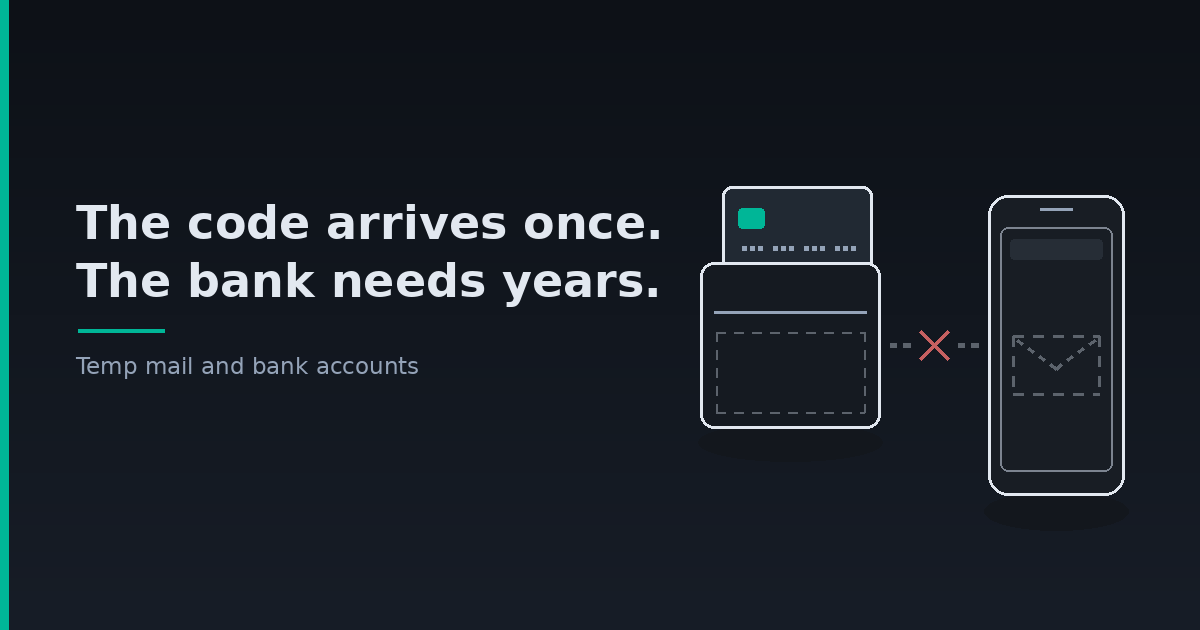
A disposable inbox is a good tool with a narrow job. It accepts one message — usually a confirmation link or a six-digit code — and after that it stops mattering. That is precisely why it works so well for a forum you will visit twice, and precisely why it fails the moment you point a bank, a brokerage or a payment wallet at it. A financial account is not a one-message relationship. It is a relationship that has to survive a lost phone, a replaced laptop, a disputed charge, a fraud alert at two in the morning, and a password you will have forgotten eighteen months from now.
The mismatch is not about trust. Disposable addresses are not shady, and using one is not a trick. The mismatch is structural: one side is designed to disappear, the other is designed to still be reachable years later.
Recovery is the whole point of the address you register
When you open an account anywhere, you are not really giving them a way to send you newsletters. You are naming the channel that proves you are you when everything else fails. Lose the phone that holds your authenticator codes, and the recovery flow goes to email. Change devices and trip the risk engine, and the one-time unlock code goes to email. Get locked out after too many wrong passwords, and the reset link goes to email.
With a bank, that is not a convenience — it is often the only path back in that does not involve a branch visit, a notarised form or a three-week support ticket. If the address you registered expired forty minutes after you used it, there is nothing on the other end to receive the link. The account still exists, the money is still there, and you have quietly removed the door.
This is the failure people actually hit, and they hit it late. Nothing goes wrong at signup. Signup works beautifully. The problem surfaces six months later, on the day you most need it to work.
Financial mail arrives long after the signup window closes
Even if you never get locked out, a financial provider keeps writing to you, and the important messages are rarely the early ones.
A card dispute opens today and the provider's decision letter lands three weeks later. A security notice tells you a login came from a city you have never visited. A broker sends a tax document in January for trades you made in March. A wallet warns that a recurring payment will be charged on Friday. A lender writes to say a direct debit bounced before it escalates the fee.
Each of those is time-sensitive, and each of them arrives long after a temporary address has been recycled. The message does not sit in a folder waiting for you. In most cases it bounces, or it is delivered to an inbox that is no longer yours in any meaningful sense. You do not get a warning that you stopped receiving your own security alerts — you simply stop receiving them, silently, which is the worst possible way for a safety net to fail.
Many disposable inboxes are open by design
There is a second issue, and it is the one most people underestimate. A large share of throwaway services work without any login at all. The address is the credential. Anyone who visits the same site and types the same address sees the same mailbox.
For a trial signup that is harmless. For a message containing a password reset link, a card's last four digits, a transaction confirmation or an account number, it is not. You have placed a key to a financial account into a drawer with no lock, in a room the public can walk into. The exposure window may be short, but attackers do not need a long one — automated tools can sit on common address patterns and read whatever lands there.
Some services do offer protected mailboxes, and a password-protected temporary inbox closes that particular hole. It still does not solve the expiry problem, which is the one that actually locks you out of your money.
Providers block disposable domains anyway — and for a reason
Try it and you will often find you cannot. Banks, regulated brokers, insurers and most serious payment platforms screen signups against lists of known disposable domains and reject them at the form.
That is not hostility toward privacy tools. Financial providers operate under know-your-customer and anti-money-laundering rules that require them to hold contact details that genuinely reach the account holder. An address with a thirty-minute lifespan does not satisfy that, and a provider that accepted it would be carrying the risk of an account it can no longer contact. If a signup form rejects your throwaway address, the form is doing its job, and working around it only moves the problem to the day you need recovery.
Worth separating two questions here: whether disposable addresses are permitted at all, and whether they are appropriate for a given account. Using a temporary address is perfectly legal in ordinary circumstances. Legal and suitable are different tests, and a bank account fails the second one.
What to use instead
The practical answer is not "use your everyday inbox for everything". It is to give financial accounts a mailbox that is boring, permanent and separate.
Create one real address used only for money — bank, cards, broker, wallet, insurance, tax. Nothing else goes there, so it never appears on a marketing list and never receives the daily noise that trains you to skim. When a message does arrive in it, that alone is a signal worth reading carefully, which makes phishing far easier to spot: a "security alert" that turns up in your shopping inbox instead of your finance one is immediately suspect.
Protect that address properly. A strong unique password, two-factor authentication on the mailbox itself, and recovery details you have actually checked this year. The mailbox is now the weakest link for every account that points at it, so it deserves more care than the accounts do.
Keep a written note of which address each financial account uses, stored with your password manager rather than in your head. Account recovery fails surprisingly often simply because the owner no longer remembers which of their four addresses they used in 2021.
Where a temp mail still earns its place
None of this is an argument against disposable addresses. It is an argument for matching the tool to the lifespan of the relationship.
A throwaway inbox is the right answer for a price alert, a one-off download, a conference wifi portal, a shop you will buy from once, a forum you are reading rather than joining, or a free trial you intend to walk away from. All of those share a shape: you need one message, you need it now, and you do not need the sender to be able to find you afterwards.
Anything holding your money has the opposite shape. You need to be findable for years, by a sender you chose, through a channel you still control. Use a disposable address for the first kind, and a well-guarded permanent one for the second — the line between them is simply whether you would mind never hearing from them again.
cover: Một ví da và một thẻ ngân hàng đặt cạnh điện thoại đang hiện màn hình "Email address not found", chụp từ trên xuống, ánh sáng dịu, tông trầm, không có logo hay tên thương hiệu nào nhận ra được. Ý của ảnh là khoảnh khắc nhận ra cánh cửa khôi phục tài khoản đã biến mất.
Tags: