Free trials without the follow-up: when a temp mail helps and when it costs you
Nobody signs up for a free trial expecting a relationship. You want to see whether the thing works, on your own files, for about twenty minutes. The company wants something more lasting, and the price of entry is your email address.
That asymmetry is why trial signups are one of the most common reasons people land here. We run TempsMail, so we see the traffic spike every time a popular tool launches a "14 days, no card required" campaign. It mostly works out. Sometimes it goes badly in a way that's entirely predictable, and that's the part worth writing down.
what you actually hand over
A trial form asks for an email. What it's really asking for is a channel it can keep using after you've lost interest.
Three things happen to that address, and only the first one is the one you consented to in your head. It receives the activation link. It goes onto a lifecycle sequence — day 1 welcome, day 3 "here's a feature you missed", day 11 "your trial ends soon", then the long tail of win-back mail that can run for a year. And in a lot of stacks it gets passed to a CRM, which may be shared with a reseller, a partner programme, or whoever buys the company in 2028.
None of that is sinister. It's just that the address you used to look at a PDF editor for ten minutes is now a durable asset on somebody's balance sheet.
where a throwaway address is clearly the right call
The signup is for a tool you're evaluating and will probably reject. Most trials end in rejection — that's what an evaluation is. If the realistic outcome is "nice, not for us", there's no reason to spend a permanent address on it.
You need one gated file. Whitepapers, templates, sample datasets, a calculator behind a form. The transaction is complete in ninety seconds and both sides know it.
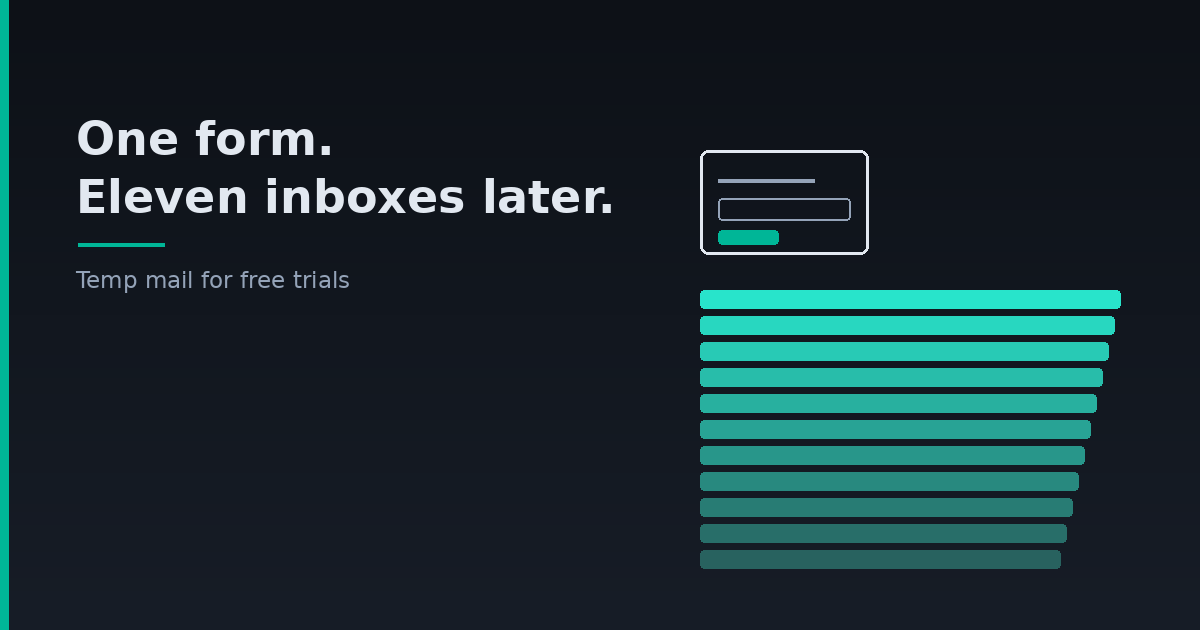
You're comparing five competitors in one afternoon. Five signups, five addresses, five inboxes you can read side by side without any of it touching your real mail. This is the case where a disposable inbox stops being a privacy gesture and starts being a genuine time-saver.
A second or third trial on a service that only allows one. Worth saying plainly: some providers consider this a breach of their terms, and a few of them detect throwaway domains and block them. We wrote about whether temp mail is safe in general terms — the short version here is that being blocked at signup is the usual failure, not anything worse.
where it will quietly cost you
This is the half that most articles skip, and it's the half our support mail is made of.
Any trial that becomes a paid account. The moment a card goes in, that email address is your receipt channel, your invoice archive, and the only way back in if you forget the password. A disposable inbox is none of those things. Messages rotate out, and the address isn't yours forever.
Anything that sends a licence key or a download that expires. People lose software licences this way every week. The key arrives, the inbox goes, the key is gone, and the vendor's support team can't reissue it to an address that no longer exists.
Trials tied to a professional identity. A design tool you'll put client work into, a repository host, anything that will later carry your name. Start it on an address you can still prove you own in two years.
Account recovery of any kind. Our inboxes have no password — they can't, because there's no account standing in front of them. We explained the full reasoning in temp mail with password. The practical consequence: if a service ever needs to verify you're the same person, a disposable address can't do it.
The rule we'd give a friend: if losing access to that mailbox tomorrow would annoy you, don't use a disposable one today.
a routine that works
Open a temporary address before you open the signup form, not after. Half the people who write to us got caught mid-form, grabbed a random address, and never kept a copy of what it was.
Copy the address somewhere you'll still have in five minutes — a note, the clipboard, anywhere. You can choose the local part on the site rather than taking the random one, which makes this much easier to remember.
Keep the tab open through the whole signup. Activation links are usually short-lived, and the inbox is live, so the message lands while you watch.
Click the activation link, finish the signup, then decide right there whether this is a trial you'll come back to. If it is, change the account's email to a real address straight away, while you're still logged in and before the disposable one lapses. Nearly every service lets you do this in settings, and doing it on day one costs nothing. Doing it on day nine is usually impossible.
If you're only here for one confirmation code, a two or ten minute address is enough, and the pattern for pulling a one-time code out of a temporary inbox applies unchanged.
what we can't do for you
We're receive-only. You can't reply to a sales rep from a TempsMail address, which matters more often than people expect — plenty of trials start a human conversation, and a bounced reply looks like you ghosted them.
We're also not private. Our inboxes have no login, so anyone who knows or guesses the address can open it. For a marketing trial that's fine. For anything with a password reset in it, it isn't, and that's not a limitation we can engineer away without turning into an ordinary mailbox provider.
And we can't help if the service refuses disposable domains outright. Some do. When that happens, the answer isn't a different throwaway — it's a second real mailbox you own, with a name unconnected to yours, kept for exactly this purpose. Five minutes to set up, and it lasts.
frequently asked questions
Will the company know I used a temporary address?
Often, yes. Disposable domains appear on public block lists, and a lot of signup forms check against them. If the form accepts the address, the mail arrives normally.
Can I use the trial, then switch to my real email later?
Usually, and that's the best version of this. Change it in account settings during the trial, not after it expires — once the account lapses, the recovery path runs through the dead address.
What if the activation email never arrives?
Check that the service didn't silently reject the domain, and try again with a different local part. If it still doesn't land, the service is filtering disposable addresses and no amount of retrying will change that.
How long do I have to read the message?
Not long, by design. Read it in the same session that triggered it. Anything you want to keep — a key, an invoice, a backup code — copy out before you close the tab.
A free trial is a small transaction, and a disposable address keeps it small. The mistake isn't using one. The mistake is using one for something that turned out not to be small, and only finding out when you needed the mailbox back. If you're new to all of this, how to get a temp mail covers the mechanics first.
Tags: