20 Minute Mail - Free Anonymous Temporary E-mail

Protect your privacy with 20 Minute Mail — a quick, secure way to avoid spam, data leaks, and unwanted emails online.

20:00

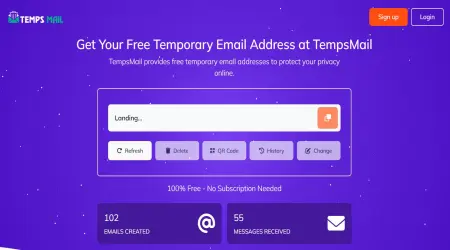
100% Free - No Subscription Needed

799,884

Emails Created

776,103

Messages Received

Sender

Subject

Time

Your inbox is empty

Waiting for incoming emails

reviews rating
Features

Why Choose 20 Minute Mail - Free Anonymous Temporary E-mail

Explore the features that make our temporary email service fast, secure, and easy to use

100% Safe

Protect your privacy by keeping spam and unwanted emails out of your personal inbox

Instant Access

Receive emails instantly with real-time inbox updates—no delays, no refresh required.

Custom Domains

Choose from multiple email domains to create a unique and secure temporary email address.

Simple & Free

Create temporary email addresses in just a few clicks. No registration required, and it’s always free to use!

Unlimited Usage

Create as many temporary emails as you need—no limits, no hidden fees, and no restrictions on usage.

Favorites Feature

Save important messages to your favorites for quick and easy access whenever you need them.

The longest window we hand out

Twenty minutes is for the slow cases. Free-trial sign-ups that verify a card before mailing anything. Marketplaces that hold the first message for review. Support desks that reply when someone reads the ticket. None of these are fast, and a five-minute inbox simply loses them.

It is also the window to pick when you are signing up to several services at once and working through them one at a time. The inbox stays with you through the whole batch.

What twenty minutes will not fix

If a service has refused the domain, no amount of waiting helps. The tell is a sign-up form that accepts the address and then sends nothing at all, which is how most disposable-domain filters behave. Try a different provider or use a real address, but do not sit through the full twenty minutes first.

Delivery delays caused by spam filtering are the other common case, and those are outside anyone's control. A message held for scanning arrives when the scanner finishes.

Before you walk away

Save anything you need out of the mailbox while it is open. Links inside the message keep working after the inbox is gone, but the message itself does not, and there is no way to bring it back. Mail is cleared from the server automatically after a few days.

Which window to pick

These pages hand out the same inbox with a different number on the clock. Choose by how long the sign-up in front of you takes.

  • 2 minutes — A download link, or a one-time code from a site you will never open again.
  • 5 minutes — An ordinary sign-up done at ordinary speed: read the form, pick a password, come back.
  • 10 minutes — The same, with room for a form that fights back.
  • 15 minutes — Registration that runs over several screens, or a sender that flushes its mail queue on a schedule.
  • 20 minutes — Free trials that check a card first, marketplaces that hold the first message for review, and a batch of sign-ups worked through one at a time.

If the domain matters more than the clock, there is a separate education-style address — read that page first, because it will not pass a student check and we are blunt about saying so.

What the number on the clock means

It is a planning figure, not a self-destruct timer. The counter tells you how long a sign-up of this shape usually takes, so you can pick a window and get on with it. It runs in your browser; closing the tab does not start or stop anything on our side.

What happens to the mail is simpler than the countdown suggests. The server clears old messages on its own after a few days. There is no password, no account, and no way to ask for an inbox back once you have walked away from it. Treat every address here as something you use once and forget — that is the whole point of it, and it is also its only guarantee.

Faqs

Frequently Asked Questions

Find answers to common questions about our temporary email service and how to use it effectively

You open the page and an address is already there — no form, no account, nothing to confirm. Paste it into whatever is asking for an email, and the verification code or confirmation link arrives in the box on this page. The twenty minutes is a guide to how long a sign-up of this kind usually takes, not a countdown to deletion: the counter runs in your browser, and the server clears old messages on its own after a few days.

Safe for what it is for, and a bad idea for anything else. Nothing is tied to your name, you never hand over a real address, and the mail is cleared automatically after a few days. But there is no password on the inbox, so treat anything that lands in it as readable by someone else. Use it for sign-up codes and newsletters. Do not use it for banking, identity documents, or any account you would be upset to lose.

No. Google asks for a phone number during sign-up and turns down disposable domains, so a temporary address will not get you a Google account. The other direction works fine: mail sent from someone's Gmail lands in this inbox like any other message, so it is still the right tool for catching a code from a Gmail user.

There is nothing to log in to. Whoever has this page open has the inbox, which is also the reason not to point anything you care about at it. The History button lists the addresses you have made, but that list is stored in this browser only — open the site somewhere else, or clear your browsing data, and the list starts empty.

No, it receives only, and that is on purpose. A throwaway inbox that can also send becomes a spam tool inside a week, and the domain ends up on every blocklist shortly after that. Keeping it one-way is what keeps the mail arriving.

Yes. Files attached to an incoming message appear with it and can be downloaded. Anything large may be refused by the mail server before it ever reaches the inbox, so treat it as dependable for a PDF invoice and unreliable for a video.

Two causes cover nearly all of it. Either the site quietly rejected the domain — plenty of forms show a success screen and send nothing at all once they spot a disposable address — or the sender is greylisting, where the first delivery attempt is refused on purpose and retried a few minutes later. Hit Refresh once. If it is still empty, use Change to get a different address and sign up again; that costs ten seconds, and staring at an empty inbox costs you the code.

Sign Up Now

Sign Up to Get Access to Exclusive Features

Register Now
Do you accept cookies?

We use cookies to enhance your browsing experience. By using this site, you consent to our cookie policy.

More